

Faceplates and Overlays
Variable Data Printing for Connected Devices
Connected devices need more than a product name and model number. Manufacturers must identify, track, and manage individual products throughout their lifecycle.
Variable data printing makes this possible by adding unique information to each printed label. This information may include QR codes, serial numbers, barcodes, or other identifiers that connect a physical device to a digital record.
For technology and communications manufacturers, variable data printing supports accurate electronics identification, product tracking, and easier access to device information.
Variable Data Printing: Use Cases and Data Models
Variable data printing allows manufacturers to change specific information from one label to the next without creating a new design for every device.
Each label can include a unique identifier while keeping the same layout, branding, and product details.
Common Uses for Connected Devices
Manufacturers use variable data printing for several important tasks:
- Device identification: Serial number labels give each product a unique identity.
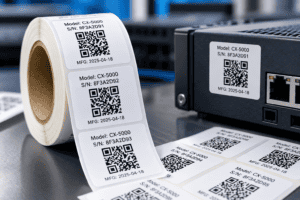
- Inventory management: Barcode labels help teams track products, parts, and equipment.
- Product traceability: Traceability labels connect devices to production records, batches, or manufacturing dates.
- Service and support: QR code labels can direct technicians to manuals, warranty details, or support pages.
- Product authentication: Product authentication labels can provide identifiers that work with a verification system.
These applications are especially useful for networking equipment, telecommunications hardware, electronic controls, and other connected products.
Building a Reliable Data Model
A data model defines what information each label contains and how that information connects to a digital system.
For example, a connected device might include:
| Data Field | Purpose |
| Serial number | Identifies the individual device |
| Model number | Identifies the product type |
| Batch number | Links the device to production records |
| QR code | Connects to product information |
| Manufacturing date | Supports production tracking |
Manufacturers should decide which information needs to appear on the label and which details should remain in a connected database.
A clear data model helps prevent duplicate identifiers, missing information, and tracking errors.
Format Selection: QR Codes, Barcodes, and Smart Labels
Choosing the right identification format depends on the device, available space, scanning equipment, and information requirements.
QR Code Labels
QR code labels store information in a two-dimensional pattern that compatible cameras and scanners can read.
They can link users to digital manuals, installation instructions, service records, or product registration pages.
For connected devices, QR codes offer a simple way to connect physical equipment with online resources.
Serial Number and Barcode Labels
Serial number labels display a unique identifier that manufacturers, service teams, and customers can reference.
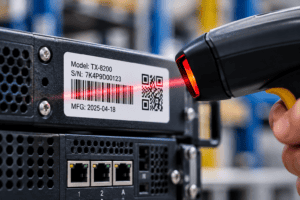
Barcode labels turn identification data into a machine-readable format. They help automate inventory checks, production tracking, and warehouse operations.
Manufacturers can combine readable serial numbers with barcodes to support both manual and automated identification.
NFC Labels and Smart Identification
NFC labels use near-field communication technology to exchange information with compatible readers at short distances.
Unlike printed QR codes, NFC labels require an electronic tag or inlay. They can be useful when a tap-based interaction fits the product design.
Smart labels may combine printed identifiers with digital features such as QR codes or NFC technology.
The best format depends on how users will access information and where the device will operate.
Durability and Scan-Grade Testing for Reliable Labels
A label must remain readable throughout its intended service life.
Connected devices may face heat, moisture, cleaning chemicals, handling, or repeated contact. These conditions can affect printed information and scanning performance.
Choosing Durable Label Materials
Material selection plays an important role in long-term identification.
Manufacturers should consider:
- Surface compatibility: Adhesives must suit the device housing or mounting surface.
- Environmental exposure: Materials should match expected temperatures, moisture, and chemical contact.
- Print quality: Text and codes need clear edges and sufficient contrast.
- Available space: Labels must fit without making important information difficult to read.
Durable connected product labels help preserve identification information during installation, maintenance, and everyday use.
Why Scan-Grade Testing Matters
A code that looks clear may still be difficult for a scanner to read.
Scan-grade testing evaluates barcode or QR code quality using applicable verification methods. Factors can include contrast, symbol size, and print consistency.
Manufacturers should select verification requirements based on the code format, scanning equipment, and application.
Testing printed samples under expected conditions can help identify problems before labels enter production.
How Variable Data Printing Supports Product Traceability
Product traceability depends on reliable identification and accurate records.
When each device has a unique identifier, manufacturers can connect that device to manufacturing information, inspection results, and service history.
For example, a technician scanning a QR code on a communications device could access its model information or maintenance instructions through a connected system.
This approach can reduce manual data entry and make product information easier to find.
However, the printed label is only one part of the process. Effective traceability also requires accurate databases, consistent identification rules, and reliable scanning procedures.
Frequently Asked Questions

What is variable data printing?
Variable data printing is a process that changes selected information on each printed item. It allows manufacturers to produce labels with unique serial numbers, barcodes, QR codes, and other identifiers.
Are QR code labels better than barcode labels?
Not always. QR codes can store more complex data or direct users to digital resources. Traditional linear barcodes work well for many inventory and tracking systems. The best choice depends on the application.
Can smart labels improve device tracking?
Yes. Smart labels can help connect devices to digital information when paired with compatible readers and tracking systems.
Choose Reliable Identification Solutions With PPS
Variable data printing helps technology and communications manufacturers identify connected devices, manage product information, and support traceability.
The right combination of label materials, identification formats, and print quality can help keep important device information accessible over time.
PPS provides durable printed components, labels, decals, overlays, and identification solutions for industrial applications.
Contact PPS to discuss variable data printing and durable identification solutions for your connected devices.