

Faceplates and Overlays
Stop Label Failure on High-Tech Plastics with Better Adhesive Selection
In electronics manufacturing, adhesive selection often determines whether a label performs for the full life of the product.
A label may look correct at first, then fail later by lifting, curling, or peeling in the field. This problem is common on engineered plastics such as ABS, polycarbonate, and plastic blends. The face stock matters, but the adhesive system usually has the biggest impact on long-term performance.
For Technology & Communication products, that matters because labels often need to stay attached and readable through assembly, shipping, installation, and service. In some cases, they also need to support durability expectations tied to UL marking and labeling requirements. That makes adhesive choice a practical engineering decision, not just a print detail.
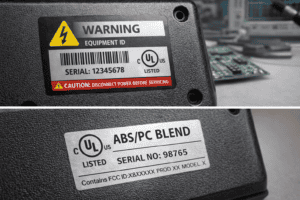
Plastics vs adhesive chemistries
Not all plastics respond to adhesives in the same way. One of the biggest challenges in adhesive selection is matching the adhesive chemistry to the actual substrate.
ABS and polycarbonate are widely used in electronics housings because they offer strength, stability, and a clean appearance. Many ABS labels and polycarbonate labels perform well with acrylic-based systems, especially when paired with a smooth, clean, and stable surface.
Acrylic adhesives are often preferred because they can provide strong holding power, good chemical resistance, and better heat performance than basic rubber-based systems. For many electronics applications, a permanent adhesive is the best choice for rating plates, warning labels, serial number labels, and instruction labels that must remain in place for years.
Still, substrate name alone is not enough. Two housings may both be called ABS, yet behave very differently. Surface texture, recycled content, additives, and molding conditions can all affect bond strength. This is also true for some plastics with low surface energy, where wet-out and long-term adhesion can be more difficult.
That is why pressure-sensitive labels should be selected based on the real application, not just the material listed on a drawing.
For products exposed to elevated temperatures, a heat-resistant adhesive may also be necessary. Without it, labels can soften, shift, or fail over time.
Surface prep and contamination
Even the right adhesive can fail if the surface is not properly prepared.
In electronics production, contamination is one of the most common causes of poor adhesion. Dust, mold release, skin oils, silicone residue, and cleaning solvents can all reduce bond strength. Some solvents evaporate quickly but leave behind residue. Others may affect the plastic surface itself.
That is why surface preparation should be part of the label specification from the start.
A good process begins with identifying the exact resin, surface finish, and cleaning method used before application. Wipe-down methods, drying time, and label application pressure should also be controlled. Small process differences can create major performance changes.
Textured and curved housings add another challenge. In these cases, the adhesive must flow well enough to fully contact the surface. If it does not, the label may appear attached at first but fail later under stress.
The key lesson is simple: specify labels for the real production environment, not for ideal lab conditions.
Peel/shear testing methods
The best way to confirm adhesive selection is through testing.
Peel testing measures how much force is needed to remove a label from the substrate. It is useful for comparing performance across different constructions and plastics. Shear testing measures resistance to sliding or creeping under load, which is especially important when labels face heat over time.
For electronics labels, testing should go beyond initial tack. True durability testing should include heat aging, humidity, abrasion, and chemical exposure. These tests help reveal whether the label system will remain attached and legible throughout the product’s life.
This is especially important for labels tied to identification, warning information, or compliance markings.
At PPS, we help manufacturers choose label constructions based on the actual substrate, environment, and performance needs. For Technology & Communication products, the right adhesive selection helps reduce field failures, improve reliability, and support long-term label performance. If your team is dealing with adhesion issues on engineered plastics, PPS can help specify durable electronics labels built for real-world use.