

.
Medical Device Labels: Durable Digital Printing Guide
Medical device labels play a critical role in product identification, safety, product tracking, and regulatory compliance. In healthcare settings, labels must stay clear, durable, and accurate throughout the product’s life. They must resist cleaning chemicals, abrasion, and frequent handling. As medical manufacturers continue to demand shorter lead times and higher customization, digital printing medical labels has become an increasingly valuable solution.
For OEMs and healthcare equipment manufacturers, selecting the right labeling approach requires balancing durability, print clarity, compliance requirements, and production efficiency.
Why Precision Matters in Medical Device Labels
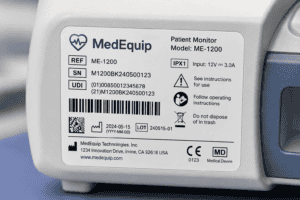
Medical environments depend on precise and legible labeling to support patient safety and equipment accuracy. Labels may contain critical information such as serial numbers, barcodes, warnings, usage instructions, and device tracking data. Poor print quality or label degradation can create risks for hospitals, clinicians, and manufacturers alike.
High clarity labels are especially important for:
- Diagnostic equipment
- Monitoring systems
- Surgical devices
- Laboratory instruments
- Portable healthcare electronics
Precision printed labels help ensure barcodes scan correctly, text remains readable, and branding maintains a professional appearance. Consistent print registration and sharp graphics are essential when labels contain small fonts, variable data, or complex layouts.
Digital printing enables quick revisions and effective version control for frequently updated labels in regulated environments.
Best Practices for Durable Healthcare Labels
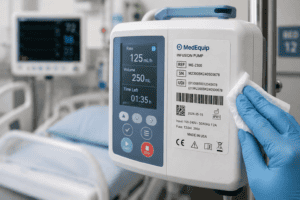
Durability is one of the most important considerations for healthcare equipment labels. Medical devices are often subjected to demanding conditions, including:
- Repeated cleaning and disinfection
- Exposure to alcohol, solvents, and chemicals
- Abrasion from handling
- Heat and humidity
- Long lifecycles
To improve label performance, manufacturers should focus on several best practices.
Select the Right Materials
The materials used for a label affect how long it lasts. Manufacturers use polyester, durable plastic materials, and specialty films for healthcare labels because these materials resist chemicals, moisture, and everyday wear.
The adhesive system is equally important. Labels must bond reliably to metals, plastics, textured surfaces, and coated enclosures without peeling or lifting over time.
Use Digital Printing for Flexibility and Accuracy
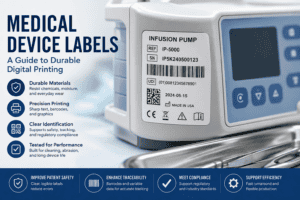
Digital printing medical labels offer several advantages for medical manufacturers, including:
- Fast turnaround times
- Variable data printing
- Consistent color reproduction
- Reduced setup costs
- Efficient short-run production
Digital technologies also allow manufacturers to produce custom medical labels with serialized information, QR codes, and unique tracking identifiers while maintaining excellent print resolution.
Prioritize Clarity and Contrast
Healthcare labels should remain readable in different lighting conditions and clinical settings. Strong contrast, clean typography, and appropriate sizing help improve usability and reduce scanning or identification errors.
For critical equipment, precision printed labels with durable protective coatings can help maintain readability after repeated cleaning cycles.
Label Durability Testing and Implementation Checklist
Before full production, manufacturers should validate label performance through durability testing. Label durability testing may include:
- Chemical resistance testing
- Abrasion testing
- Adhesion testing
- Temperature and humidity exposure
- Cleaning process testing
Testing helps confirm that labels will continue performing under real-world healthcare conditions.
Medical Device Labeling Checklist
When evaluating medical print solutions, manufacturers should confirm:
- Materials that work well with the device surface
- Resistance to cleaning agents and disinfectants
- Barcode and variable data readability
- Long-term adhesive performance
- Compliance with applicable regulated labeling requirements
- Print clarity for small text and graphics
- Ability to handle future production needs
Medical device labels do more than identify a product. They help improve safety, product tracking, ease of use, and long-term performance in healthcare environments. By using durable materials, quality printing, and proper testing, manufacturers can make labels that last longer. These labels perform reliably.
PPS provides custom medical labels and healthcare equipment labels designed for durability, clarity, and production flexibility. Contact PPS to discuss medical print solutions tailored to your application requirements.