

Faceplates and Overlays
Medical equipment controls must be easy to operate, but they also need to handle the realities of clinical use. Frequent button presses, routine cleaning, spills, and repeated handling can put stress on the interface.
Medical membrane switches give OEMs a low-profile control option that can combine printed graphics, circuitry, tactile feedback, and a cleanable outer surface in one assembly. When materials and construction are selected for the application, the result can be a durable medical interface designed around both usability and environmental demands.
Medical Membrane Switches: Layer Stack and Options
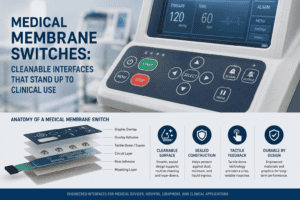
A membrane switch may look simple from the outside, but several layers work together below the surface. A typical design starts with a printed graphic overlay and adds adhesives, spacer layers, conductive circuitry, and a mounting adhesive.
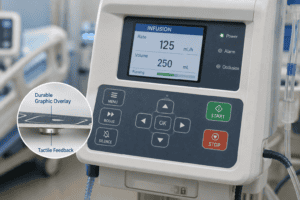
The graphic overlay is the part clinicians and technicians see and touch. It can display button functions, instructions, symbols, status areas, and branding. Printing graphics beneath the surface of an overlay can also help protect them from direct abrasion and cleaning exposure.
Under the overlay, the membrane switch keypad contains the electrical switching system. Flexible printed circuits commonly use polyester films with conductive traces. Spacer layers maintain separation between contacts until the operator presses a key.
Medical OEMs can also customize features based on how the equipment will be used. Options may include:
- Tactile or non-tactile keys
- Metal domes for physical feedback
- Embossed key areas
- LED indicators or backlighting
- Custom colors, symbols, and graphics
- Flexible circuit tails and connector options
- Shielding for application-specific electrical requirements
- Custom mounting and adhesive systems
A tactile membrane switch, for example, gives the user physical feedback when a button is pressed. This can be useful when operators need confirmation of an input without relying only on a display or audible signal.
Sealing and Cleanability Improve Medical Membrane Switch Reliability
Cleanability should be considered early in the design of a medical device interface. Hospital and clinical equipment may be wiped down frequently, so the exposed surface and assembly construction need to match the intended cleaning process.
One advantage of a membrane interface is its continuous outer surface. Compared with controls that have openings around individual mechanical buttons, a properly designed membrane switch can reduce gaps where liquids and debris may enter.
However, “sealed” does not automatically mean waterproof. The perimeter design, adhesives, enclosure, tail exit, and other construction details all affect resistance to liquid ingress. Additional sealing methods may be necessary when an application requires a specific level of environmental protection.
Material selection also matters. The overlay should be evaluated against the cleaners and disinfectants expected in the actual use environment. Hard-coated films and protected graphics can improve resistance to abrasion and chemical exposure, but requirements should be verified for each application.
For a sealed medical keypad, OEMs should define expected cleaning agents, cleaning frequency, liquid exposure, operating conditions, and durability requirements before finalizing the design.
This application-specific approach helps PPS determine the right combination of materials, adhesives, graphics, circuitry, and construction for hospital equipment controls.
Prototype to Production: Medical Membrane Switch RFQ Checklist
The earlier an OEM defines its requirements, the easier it is to evaluate a membrane switch design for manufacturability.
Before requesting a quote for a medical OEM interface, gather as much of the following information as possible:
- Overall dimensions and mechanical drawings
- Button locations, sizes, and functions
- Tactile or non-tactile requirements
- Overlay material and surface finish
- Graphic artwork and color requirements
- Embossing requirements
- Tail location, length, pitch, and pinout
- Connector or termination requirements
- LED or backlighting requirements
- Shielding requirements
- Mounting surface and enclosure details
- Expected operating environment
- Cleaning agents and cleaning frequency
- Sealing or environmental requirements
- Prototype and estimated production quantities
If every specification is not finalized, early supplier involvement can still be useful. Prototypes can help teams evaluate key spacing, tactile response, graphics, fit, connector placement, and overall usability before moving toward production.
Building Cleanable Controls for Clinical Equipment
A successful healthcare HMI has to do more than look clean. Its materials, layer construction, tactile response, sealing strategy, graphics, and electrical design all need to work together.
For medical OEMs, medical membrane switches provide a flexible way to build compact, cleanable controls for diagnostic systems, monitoring equipment, laboratory devices, portable equipment, and other clinical applications.
PPS manufactures durable printed components, labels, decals, overlays, membrane switches, faceplates, and identification products for demanding applications. Contact PPS to discuss durable printed components, membrane switches, overlays, or identification solutions for your medical application.
Frequently Asked Questions
What is a medical membrane switch?
A medical membrane switch is a thin electrical interface that uses layered films and conductive circuitry to provide keypad or control functions for medical equipment. Designs can incorporate graphics, tactile feedback, lighting, sealing, and custom connection options.
Are membrane switches easy to clean?
Their continuous outer surface can make membrane switches well suited to applications requiring frequent wipe-downs. The overlay material, adhesives, sealing design, and resistance to the intended cleaning agents should be evaluated for the specific application.
Can a medical membrane switch provide tactile feedback?
Yes. Metal domes or other tactile mechanisms can provide physical feedback when the operator activates a key, helping confirm that an input has been made.
What information does PPS need to quote a medical membrane switch?
Useful RFQ information includes dimensions, artwork, button layout, tactile requirements, tail and connector specifications, cleaning conditions, sealing needs, mounting details, and expected production quantities.