

Faceplates and Overlays
Military-Grade Adhesives for Harsh Environments
A label can use durable film, protected graphics, and clear identification data yet still fail when its adhesive does not match the equipment surface. Military-grade adhesives help harsh environment labels remain attached through moisture, vibration, temperature changes, outdoor exposure, cleaning, and contact with operational fluids.
However, “military-grade” does not describe one universal adhesive or automatically prove compliance with every military requirement. It should describe an adhesive system selected and tested for a specific defense or aerospace application. Projects governed by a contract or drawing must be evaluated against the applicable military specifications.
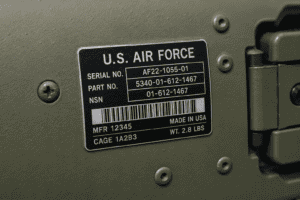
For aircraft identification labels, defense labels, rugged decals, and durable nameplates, reliable identification depends on the complete construction. That includes the face material, printed graphics, protective finish, adhesive, substrate, preparation method, and application process.
Substrate and Surface Energy
The substrate is the surface that receives the label. Common examples include aluminum, stainless steel, painted metal, powder-coated housings, composites, and molded plastics.
Surface energy affects how well an adhesive spreads across the substrate. This spreading action is called adhesive “wet-out.” Metals and glass typically have higher surface energy and are easier to bond. Plastics such as polyethylene and polypropylene have lower surface energy, which can make bonding more difficult.
Texture, curvature, paint chemistry, oil, dust, mold-release residue, and handling contamination can also reduce adhesive contact. A general-purpose adhesive that performs well on smooth aluminum may lift from a textured plastic or powder-coated enclosure. Technical guidance from 3M explains how surface energy and contamination influence adhesive wet-out.
Surface preparation must therefore be part of the label specification. Teams should document the approved cleaning method, application temperature, installation pressure, and time allowed for the bond to build before the equipment enters service.
Military-Grade Adhesives: Selection Framework
Begin with the exact housing material and finish. “Painted metal” is rarely enough information because coating chemistry and texture can change adhesive performance. Whenever possible, test production labels on representative parts from the same finishing process.
Next, map the operating environment. Will outdoor equipment labels face rain, sunlight, salt, hydraulic fluid, aviation fuel, oils, cleaners, or temperature cycling? Chemical resistant labels need more than a resistant adhesive. The printed surface and protective layer must also remain readable after the expected exposure.
Weatherproof labels require the same complete-system approach. Temperature range, exposure time, fluid concentration, cleaning method, and expected service life should all guide the material decision. PPS offers labels, decals, stickers, and tags with custom-engineered adhesive options for demanding indoor and outdoor applications.
Mechanical stress also matters. A flexible label on a tight curve may pull against its own edges. Thick, durable nameplates may place more stress on the adhesive during vibration or thermal expansion. High initial tack supports installation, while shear resistance helps prevent gradual movement under a sustained load.
Some low-surface-energy plastics or heavily textured finishes may require a specialized adhesive, thicker adhesive layer, approved primer, or alternate attachment method. The decision should follow application testing rather than a generic “strongest adhesive” rule.
Peel, Shear, and Environmental Testing
Testing should reproduce the actual surface, preparation process, application pressure, and exposure sequence. Results obtained on clean laboratory stainless steel may not predict performance on a painted aircraft component or powder-coated field enclosure.
Peel testing measures the force required to pull a flexible label away from a surface at a controlled angle and speed. Shear testing evaluates the adhesive’s ability to resist a load acting parallel to the surface over time. ASTM International, formerly the American Society for Testing and Materials, publishes recognized methods for peel adhesion testing and shear adhesion testing. The correct method and acceptance criteria should be selected for the application.
Environmental testing may include:
- Temperature cycling and elevated-temperature exposure
- Humidity, water, salt, and outdoor weather
- Fuels, oils, solvents, cleaners, and hydraulic fluids
- Ultraviolet light exposure
- Abrasion, vibration, and repeated handling
- Inspection for edge lifting, movement, bubbles, or lost legibility
Buyers sometimes search for abrasion proof tags, but no identification product is immune to every type of wear. A stronger specification defines the abrasive material, number of cycles, applied force, and required legibility after testing.
How Can Identification Failure Be Prevented?
Before approving military-grade adhesives, confirm the exact substrate and coating, document surface preparation, and list all environmental exposures. Test representative labels on production-equivalent parts and establish measurable limits for edge lifting, movement, peel strength, and readability.
The construction should be reevaluated whenever the housing material, paint, adhesive, cleaning process, or application procedure changes. This helps prevent small production changes from creating unexpected field failures.
This adhesive-focused process also supports military membrane switches, graphic overlays, and control panels. Their mounting adhesives must secure the interface construction to the equipment housing while supporting the expected service environment.

Frequently Asked Questions
What makes an adhesive military-grade?
There is no single adhesive that is suitable for every military application. The adhesive must match the surface, environment, service life, drawing, installation process, and required test plan.
Are stronger adhesives always better?
No. Selection must balance initial tack, peel adhesion, shear resistance, conformability, temperature performance, chemical exposure, and application needs. A high-strength adhesive can still fail when it cannot wet out the substrate.
How can edge lifting be reduced?
Use clean surfaces, rounded label corners, sufficient application pressure, and a construction that follows the surface curvature. Testing should include the expected temperature range, fluids, vibration, and dwell time.
Build More Reliable Identification with PPS

Military-grade adhesives can help prevent identification failure when they are selected as part of a complete, tested label system. PPS works with military and aerospace customers on defense labels, rugged decals, weatherproof labels, chemical resistant labels, durable nameplates, aircraft identification labels, and other military identification solutions.
Contact PPS to discuss durable printed components, labels, decals, overlays, or identification solutions for your military or aerospace application.