

Faceplates and Overlays
UDI labels help medical device manufacturers identify products consistently as they move through manufacturing, distribution, inventory, and use. A strong labeling strategy must address more than printing a barcode. It should consider data structure, serialization, barcode readability, materials, adhesives, environmental exposure, and documentation.
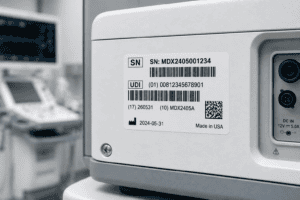
Under the FDA’s Unique Device Identification system, most covered devices must carry a unique device identifier on their labels and packages unless an exception or alternative applies. The UDI generally contains a fixed Device Identifier (DI) and, when applicable, a variable Production Identifier (PI). The PI can identify information such as a lot, batch, serial number, expiration date, or manufacturing date. (U.S. Food and Drug Administration)
For medical manufacturers, combining the right barcode labels and serial number labels can create a practical foundation for product identification and traceability.
UDI Labels: Understanding Standard Scope
A UDI must generally appear in easily readable plain text and in a machine-readable automatic identification and data capture (AIDC) format. The FDA does not prescribe one universal AIDC technology for every application, making the device, issuing agency requirements, label space, and scanning environment important parts of the specification process. (U.S. Food and Drug Administration)
Manufacturers should first determine which UDI requirements apply to the specific device and packaging configuration. Certain reusable devices that are intended to be reprocessed before each use may also require the UDI to be permanently marked on the device itself. Exceptions and alternatives can apply, so requirements should be evaluated for the individual product. (U.S. Food and Drug Administration)
The physical medical traceability labels also need to perform in their actual environment. Consider exposure to:
- Cleaning agents and chemicals
- Abrasion and repeated handling
- Moisture and temperature changes
- Curved or textured surfaces
- Repeated barcode scanning
- Long equipment service lives
These factors can influence the label material, adhesive, protective construction, print method, and barcode design.
Spec/RFQ Checklist and Documentation for UDI Labels
A detailed RFQ helps a label manufacturer understand both the identification requirements and the physical application. Before requesting regulated identification labels, manufacturers should define the data, substrate, environment, expected life, and verification needs.
A useful specification checklist includes:
- Label dimensions and available application area
- Device or packaging substrate
- Required human-readable information
- Barcode or AIDC symbology
- Device Identifier requirements
- Variable Production Identifier data
- Lot, batch, or serial number requirements
- Expected quantity and number of variable records
- Adhesive and material requirements
- Chemical, abrasion, moisture, and temperature exposure
- Barcode verification requirements
- Artwork and revision controls
- Packaging and delivery requirements
Variable data is especially important when serial number labels must provide unique identification for individual devices. A controlled data workflow can help prevent duplicate, missing, or incorrectly associated serial numbers.
Manufacturers should also coordinate their physical label data with their GUDID responsibilities. The FDA-administered GUDID contains the DI and associated device information; it does not contain PI information such as individual serial numbers. (U.S. Food and Drug Administration)
Validation, Testing, and Common Audit Pitfalls
A barcode that looks correct is not automatically suitable for its intended use. Durable barcode labels should be evaluated under conditions that reflect the actual device environment and expected handling.

Depending on the application, testing may evaluate adhesion, abrasion resistance, chemical exposure, temperature, moisture, and barcode readability. Acceptance criteria should be established based on the manufacturer’s device requirements and quality processes.
For devices subject to direct-marking requirements, FDA guidance states that the marking should last throughout the device’s expected service life while accounting for expected use and reprocessing. FDA also expects labelers to assess the effect of direct marking on device safety and effectiveness where applicable. (U.S. Food and Drug Administration)
Common problems to address before production include poor barcode contrast, insufficient quiet zones, incorrect variable data, duplicate serial numbers, unsuitable adhesive selection, and a mismatch between approved data and the finished label.
Documentation matters too. Artwork approvals, revisions, variable-data files, inspection criteria, and verification records can help create a clearer history of how product identification medical labels were produced and controlled.
Building Traceability Beyond the Barcode
UDI is one part of a larger identification strategy. Manufacturers may also use equipment tracking labels, asset identifiers, serial numbers, and healthcare inventory labels to connect physical devices with internal manufacturing, service, inventory, or asset-management systems.
The best strategy begins with the information that must remain connected to the product and then builds the label construction around its environment. That approach helps manufacturers balance machine readability, human-readable identification, durability, and production efficiency.
FAQ: UDI Labels and Medical Device Identification
What information is included in a UDI?
A UDI generally includes a fixed Device Identifier and may include Production Identifier information such as a lot or batch number, serial number, expiration date, or manufacturing date. (U.S. Food and Drug Administration)
Does GUDID store medical device serial numbers?
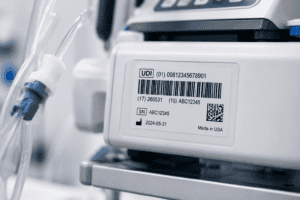
No. FDA states that GUDID contains the Device Identifier and associated device information, but it does not contain Production Identifier data such as individual serial numbers. (U.S. Food and Drug Administration)
Do UDI labels need to be durable?
Label construction should match the intended application and expected exposure. Medical devices exposed to cleaning, abrasion, moisture, temperature changes, or extended handling may require materials, adhesives, and protective constructions designed for those conditions.
Plan Your UDI Label Strategy With PPS
Effective UDI labels combine accurate data with barcode readability, serialization control, appropriate materials, and a construction suited to the device environment. Addressing those factors early can make identification and traceability easier to manage throughout production and use.
PPS manufactures durable printed components and identification solutions for demanding applications. Contact PPS to discuss durable printed components, labels, decals, overlays, or identification solutions for your medical application.