

Faceplates and Overlays
Variable Data Labels for Defense and Aerospace Tracking
In defense and aerospace, one wrong label can slow receiving and maintenance work. A duplicate serial number or unreadable code can break the link between an asset and its record.
Variable data labels help teams give each item a unique identity. They can include serial numbers, barcodes, UID data, lot codes, part numbers, and other changing fields. When the data, material, and print quality work together, these labels support reliable scans and tracking.
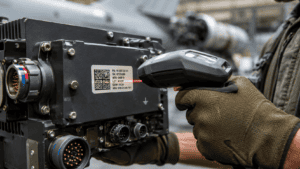
Variable Data Labels: Use Cases and Data Model
Military tracking labels support receiving, maintenance, storage, and field service. Aerospace asset tags identify assemblies, tools, containers, and replaceable parts.
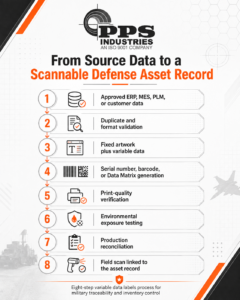
Start by defining the data model. This means deciding which fields each label needs, where the data comes from, and how it connects to the asset record.
A data model should define:
- The approved data source
- Required text and encoded fields
- Serial number rules
- Allowed characters and field lengths
- Duplicate checks
- Revision control
- Reprint and scrap rules
The source may be an ERP, MES, PLM, or approved customer file. Teams should avoid manual edits for large batches. One spreadsheet error can create hundreds of wrong labels.
For more background, see PPS’s guide to Defense ID Labels for Asset Control.

Format Selection for UID, Barcode, and Serial Labels
The right format depends on the contract, scanner, label size, and work process.
UID labels use a 2D Data Matrix code. They may support Item Unique Identification when a defense contract requires it. Teams should review the contract, drawing, and current marking rules before production.
Barcode labels work well for receiving, warehouse control, and equipment tracking. Linear barcodes need enough width and clear space around the code. A barcode that is too small may fail during scanning.
Serial number labels offer a simple visual ID. They can work alone or with a barcode. The printed serial number and encoded value must always match.
Many programs use both human-readable text and a machine-readable code. This gives teams a backup when a scanner is not available or the code is damaged.
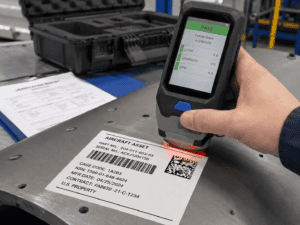
Durability and Scan-Grade Testing
A label must stay attached, remain readable, and keep scanning through its service life.
The label material and adhesive should match the equipment surface and expected exposure. Common risks include heat, cold, fuels, oils, cleaners, moisture, UV, and abrasion.
PPS explains these factors in Military-Grade Adhesives for Harsh Environments.
Teams should test the final label on a matching surface. They should test it after exposure, not only when it is new.
A test plan may include:
- Verify the code before exposure.
- Apply the label to the target surface.
- Expose it to heat, fluids, cleaning, moisture, or abrasion.
- Check for lifting, fading, or damage.
- Scan and verify the code again.
One scan alone does not prove code quality. Scan-grade testing can measure contrast, print growth, damaged cells, and other issues. The drawing or quality plan should define the required grade and test method.

How to Scale Without More Errors
Large runs need strong controls. Teams should check for duplicate IDs, missing values, lost leading zeros, bad dates, and mismatched text before printing.
They should approve sample records, including the first, last, longest, and shortest values. After production, accepted labels should match the approved data file. Reprints and scrapped labels should be tracked.
Test After Environmental Exposure
Initial verification is only the baseline. For durable barcode labels, evaluate scan performance after the expected exposure sequence:
- Verify the symbol before exposure.
- Apply the label to a production-equivalent substrate.
- Allow the adhesive to build under the approved process.
- Expose samples to defined temperature, chemical, abrasion, moisture, UV, or cleaning conditions.
- Inspect for lifting, fading, damage, or lost contrast.
- Reverify the code against the acceptance limit.
- Test with the actual field scanner when practical.
The order of exposure matters. Abrasion after chemical contact may produce a different result than testing each condition separately.
Control Placement and Scanner Access
Avoid locations where a cable, bracket, panel, or routine grip will cover or damage the label. Curved surfaces can distort a code. Recessed locations may create shadows or prevent the scanner from reaching the correct angle.
The drawing should define orientation, clearance, and placement tolerance. On small parts, balance code size, human-readable text, and available space rather than shrinking every element.
A Practical RFQ Checklist for Defense and Aerospace Buyers
A complete RFQ helps PPS review manufacturability, risk, and testing needs before production. Include:
- Label drawing and revision
- Governing contract, specification, or customer standard
- Required variable fields and sample data
- Barcode or 2D symbol type
- Required syntax and verification grade
- Human-readable content
- Label dimensions and placement
- Equipment substrate and finish
- Temperature, fluid, abrasion, UV, moisture, and cleaning exposure
- Required service life
- Quantity per lot and annual volume
- Packaging sequence
- Proof, first article, and documentation requirements
- Reconciliation or production-report requirements
- Actual scanner model when scan performance is critical
This information turns a label quote into a controlled manufacturing plan.
Related PPS Resources
For a broader overview, review Defense ID Labels for Asset Control. For attachment risks, see Military-Grade Adhesives for Harsh Environments. Teams developing complete operator interfaces can also explore Military Membrane Switches for Reliable Controls.
PPS provides labels, decals, stickers, and tags and supports projects guided by applicable military specifications.
Frequently Asked Questions
What information can variable data labels include?
They can include serial numbers, UID data, part numbers, lot codes, date codes, asset IDs, revisions, linear barcodes, Data Matrix symbols, QR codes, and other item-specific fields. The correct content depends on the contract, drawing, workflow, and system of record.
Are UID labels required for every military asset?
No. UID requirements depend on the applicable contract, DFARS clause, program rules, and item criteria. Review the governing documents before specifying the label.
What is the difference between a barcode label and an asset tracking label?
A barcode label describes the machine-readable format. An asset tracking label describes the function. An asset tracking label may use a linear barcode, Data Matrix symbol, QR code, serial number, or a combination.
How do you prevent duplicate serial number labels?
Use one controlled source of truth, validate the file, lock approved number ranges, track reprints and scrap, and reconcile accepted output against the approved file.
Should every barcode be verified?
The contract, drawing, quality plan, or customer specification should define inspection and sampling. High-risk programs may require more verification than general inventory labels.
What makes a barcode label durable?
A durable barcode label uses a construction matched to the surface, environment, handling, and service life. Its code must also retain enough print quality and contrast to meet the required scan grade after exposure.
Build Traceability Into the Label Program
Variable data labels deliver value when accurate data, suitable formats, durable materials, and measurable verification work as one system. That system can support inventory control, equipment tracking, maintenance, and lifecycle traceability across military and aerospace operations.
PPS manufactures durable printed components, labels, decals, overlays, and identification solutions for demanding applications. Submit an RFQ to PPS with your data fields, drawing, substrate, exposure profile, scan requirements, quantity, and documentation needs. PPS can review the application and help define a production-ready approach for your variable data label program.